
On June 8, 1625, the revolt Nueva Segovia (present day Cagayan province) took place in a village called Abulag led by Don Miguel Lanab and a person only known as Alababan. The rebellion started with the killing of Fray Alonso Garcia and Fray Onofre Palao by Lanab and Alababan, followed by burning a church.

Significant Events in June in Filipino History
On , the American colonial government in Manila formally brought charges of illegal possession of firearms, conspiracy, rebellion, and insurrection against General Artemio Ricarte. Universally known by his nom de guerre Vibora (The Viper), Ricarte was not just another insurgent to the American authorities - he was the ultimate symbol of unyielding Filipino resistance.
On June 9, 1975, a significant milestone in Philippine foreign policy was achieved when the Philippines and the People’s Republic of China formally established diplomatic relations. This event marked a turning point in Southeast Asian diplomacy during the Cold War era, as the Philippines shifted from recognizing the Republic of China (Taiwan) to engaging directly with Beijing.
Críspulo Aguinaldo y Famy stands as a primary example of the "Sacrificial Leadership" that characterized the Magdalo faction of the Katipunan. As the elder brother of the first president, Emilio Aguinaldo, his life offers a narrative that bridges the gap between the traditional elite of the Spanish colonial era and the radicalized insurgents of the late nineteenth century. His death at the Battle of Pasong Santol in March 1897 was not merely a military loss but a pivotal moment that allowed for the formal establishment of the First Philippine Republic.
Neptali Alvaro Gonzales, Sr. was a towering figure in Philippine politics, law, and education. Known for his intellect, compassion, and unwavering commitment to public service, Gonzales rose from humble beginnings to become one of the nation's most respected statesmen. His life is a testament to the power of perseverance, education, and dedication to the common good. Serving as Senate President of the Philippines during three distinct terms - 1992 to 1993, 1995 to 1996, and 1998 - he left an indelible mark on the country's legislative and social landscape.
On , President Ferdinand Marcos Sr. signed Presidential Decree No. 1530, officially establishing the Home Development Mutual Fund (HDMF). Today, millions of Filipinos recognize this institution by its iconic and comforting acronym: the Pag-IBIG Fund.
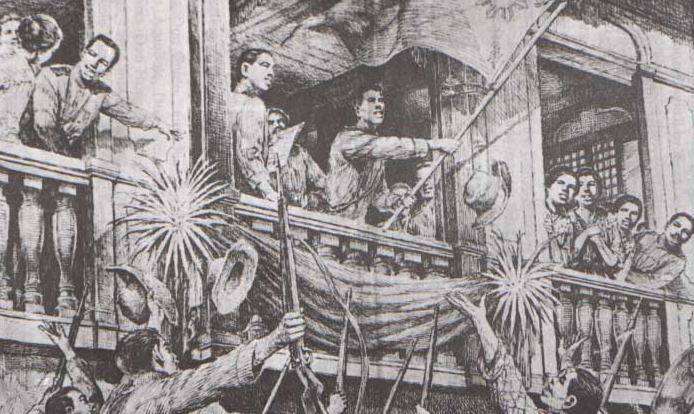
On June 12, 1962, the "June 12" Philippine Independence Day, was observed for the first time throughout the country and was celebrated most impressively in Manila. Both President Diosdado Macapagal and the aged General Emilio Aguinaldo took part in the afternoon ceremonies on the Luneta.
The celebration included a Philippine Armed Forces largely motorized parade which took two hours to pass the Luneta grandstand and in which several small units of the United States Army and Air Force participated, and a civic parade which took an hour longer. President Macapagal delivered one of the most eloquent addresses of his career.